

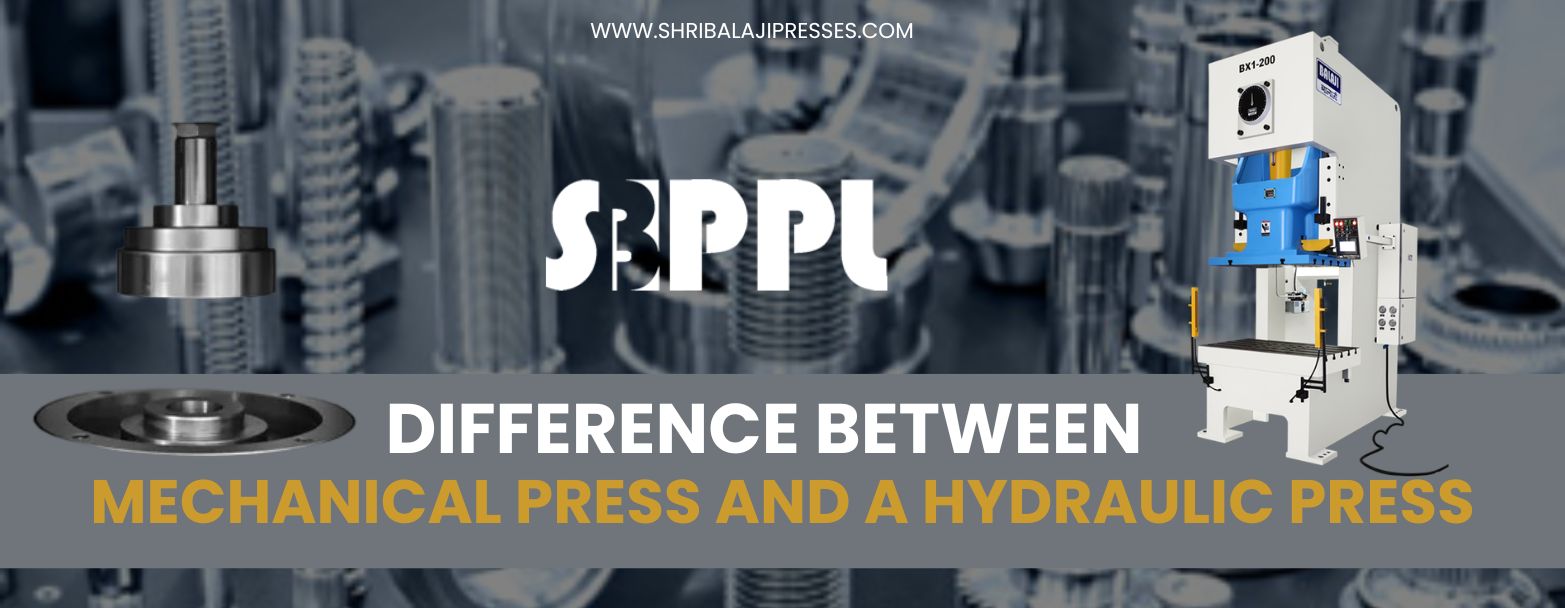
In modern manufacturing and even in everyday applications, presses play a crucial role in shaping, forming, and assembling materials. Two of the most widely used types are mechanical presses and hydraulic presses. While both perform similar functions, their working principles, capabilities, and applications differ significantly.
Understanding these differences can help industries—and even individuals—choose the right solution for their needs.
What Is a Mechanical Press?
A mechanical press uses a motor-driven system (typically a flywheel, crankshaft, and gears) to generate force and perform operations like stamping, punching, or cutting.
- It works by converting rotational energy into linear motion.
- Known for high speed and efficiency, especially in repetitive tasks.
- Best suited for mass production environments.
Think of it as a fast, powerful machine designed for consistency and speed.
What Is a Hydraulic Press?
A hydraulic press uses fluid pressure to generate force. It operates based on hydraulic principles where pressure applied to a fluid is transmitted uniformly.
- Uses cylinders, pumps, and hydraulic fluid to apply force.
- Offers precise control over pressure and speed.
- Ideal for complex and detailed operations.
In simple terms, it’s slower but far more flexible and controlled.
Key Differences Between Mechanical and Hydraulic Press
1. Working Principle
- Mechanical Press: Uses mechanical components like flywheels and gears
- Hydraulic Press: Uses fluid pressure and cylinders
2. Speed vs Control
- Mechanical Press: Faster, high production rate
- Hydraulic Press: Slower but highly controlled
3. Force Application
- Mechanical Press: Maximum force at a specific point in stroke
- Hydraulic Press: Constant force throughout the stroke
4. Flexibility
- Mechanical Press: Limited adjustability
- Hydraulic Press: Adjustable pressure, speed, and stroke
5. Precision
- Mechanical Press: Good for repetitive tasks
- Hydraulic Press: Superior precision and control
Applications in Industry
Mechanical Press Uses
Mechanical presses are widely used in industries where speed and volume are critical:
- Metal stamping and sheet cutting
- Automotive component manufacturing
- Electronics and appliance production
- Mass production lines
Ideal for producing large quantities quickly with consistent results.
Hydraulic Press Uses
Hydraulic presses are preferred in industries requiring precision and versatility:
- Deep drawing and metal forming
- Forging and molding
- Aerospace and heavy engineering
- Powder compaction and composite materials
Perfect for complex shapes and controlled operations.
Uses in Everyday Life
While presses are often associated with heavy industries, they also have applications in daily life:
Mechanical Press (Everyday Examples)
- Coin minting
- Simple punching or stamping tools
- Small workshop machinery
Hydraulic Press (Everyday Examples)
- Car repair tools (e.g., bearing press)
- Juice or oil extraction machines
- Garbage compactors
- DIY workshop presses
Which One Should You Choose?
The choice depends on your specific needs:
- Choose a mechanical press if you need speed, efficiency, and mass production
- Choose a hydraulic press if you need precision, flexibility, and control
In many industries, both types are used together to optimize production.
Conclusion
Both mechanical and hydraulic presses are essential tools in manufacturing and daily applications. While one focuses on speed and consistency, the other emphasizes precision and adaptability. Understanding their differences ensures better productivity, cost efficiency, and product quality.
Looking for high-quality press machines for your business? Explore our advanced and reliable solutions at Shri Balaji Power Press, Whether you need mechanical or hydraulic presses, expert guidance and top-tier machinery can help you take your production to the next level.


